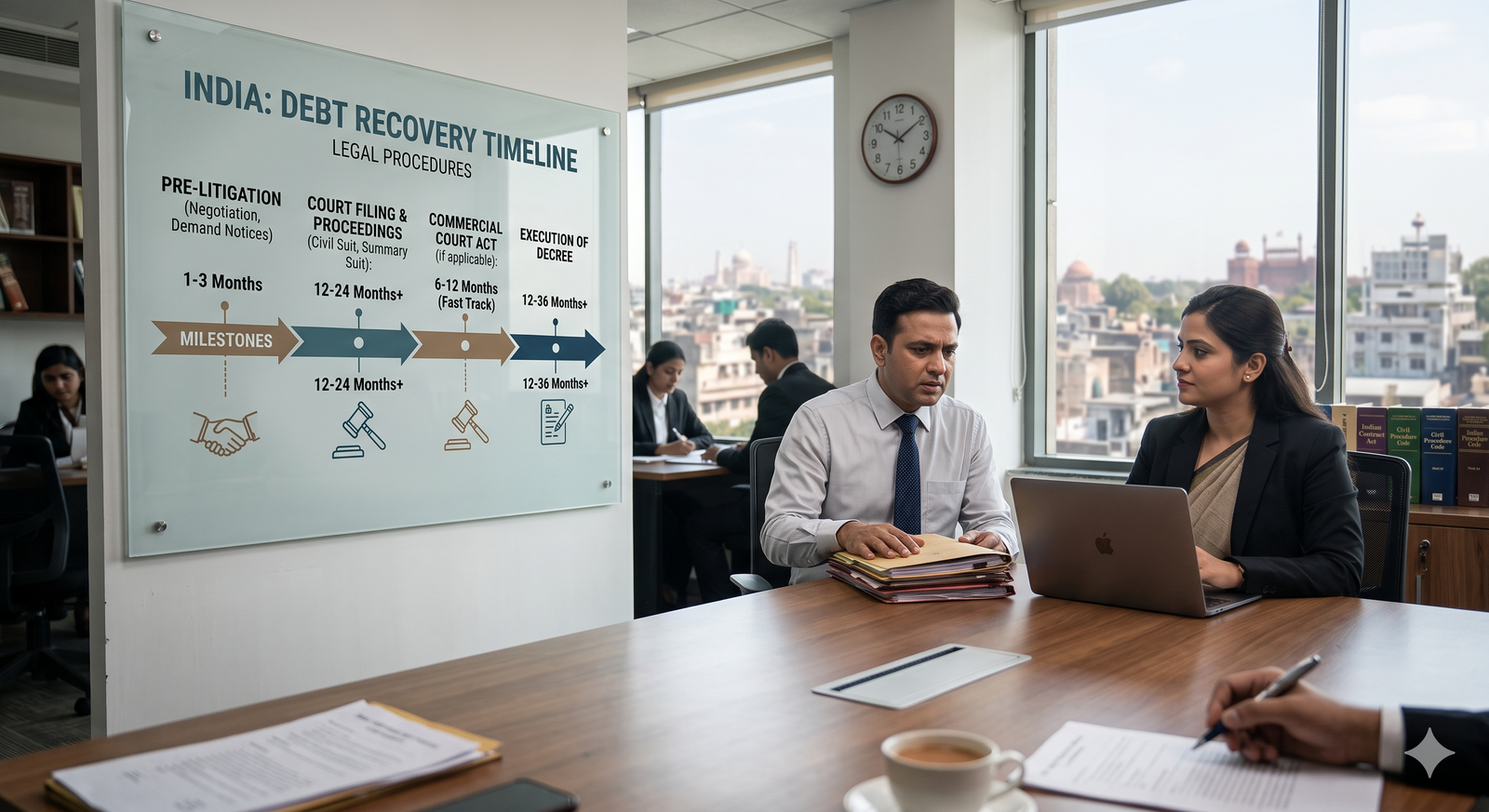
"How long will this take?" is usually the first question a business asks once a client stops paying. The honest answer: it depends entirely on which route you take. A friendly reminder can resolve things in days. A contested civil suit can take years. Most businesses don't realize there's a whole spectrum of speed in between — and picking the right tool for your situation is often what determines whether you're paid in weeks or stuck waiting for a court date two years out.
Here's a realistic, method-by-method breakdown.
Quick Answer
| Recovery Method | Typical Timeline |
|---|---|
| Direct negotiation / payment plan | Days to 2-3 weeks |
| Legal notice | 2-4 weeks (notice period + response window) |
| MSME Samadhaan (conciliation stage) | 4-12 weeks |
| MSME Samadhaan (arbitration stage, if conciliation fails) | 3-6 months |
| Lok Adalat | Days to a few weeks (single sitting, if both parties agree) |
| Arbitration (private, contractual) | 6-18 months |
| Section 138 NI Act (bounced cheque) | 6 months to 2+ years |
| Civil recovery suit (Commercial Courts) | 1-3 years (longer if appealed) |
| IBC Section 9 (insolvency, ≥ ₹1 crore) | 3-6 months to admission, faster pressure effect |
These are realistic ranges, not guarantees — actual timelines depend heavily on how contested the claim is, court/tribunal backlogs in your jurisdiction, and how quickly you act.
What Actually Drives the Timeline
1. Whether the Debt Is Disputed or Undisputed
This is the single biggest factor. If the client doesn't dispute the amount owed — they just haven't paid — almost every recovery route moves faster, because there's nothing to argue over. The moment a client disputes quality, delivery, or contract terms, every process slows down significantly, since now there's a substantive dispute to adjudicate.
2. How Quickly You Act
Limitation periods matter. Under the Limitation Act, 1963, you generally have 3 years from the due date to initiate recovery proceedings. Acting within the first few months of default — while documentation is fresh and before the client's situation deteriorates further — consistently produces faster outcomes than waiting.
3. Which Forum You Choose
Different forums move at very different speeds:
- MSME Samadhaan and Lok Adalats are designed to be faster and less procedural than regular courts
- Arbitration is generally faster than litigation, but still involves pleadings, hearings, and an award — so it's not instant
- Civil courts, even fast-track Commercial Courts, carry case backlogs that can stretch timelines regardless of how strong your case is
4. Whether You Have an Arbitration Clause
If your contract specifies arbitration, you skip the years-long civil court queue entirely and go straight to a private process — often one of the biggest timeline differences in this whole list.
5. Documentation Quality
Cases with a clean paper trail — signed PO, delivery proof, written acknowledgment of dues — move faster at every stage, because there's less for the other side (or the tribunal) to question.
A Closer Look at Each Method
Direct negotiation: If the client genuinely intends to pay and just needs structure, a written payment plan can resolve things within days to a couple of weeks. This is always worth attempting first since it costs nothing and loses you no time if it doesn't work.
Legal notice: A notice typically gives the debtor 15 days to respond, plus time to draft and serve it — so expect roughly 2-4 weeks before you know if it's working. A large share of cases settle at this stage simply because the client wants to avoid further escalation.
MSME Samadhaan: Conciliation, the first stage, usually plays out over a few sittings across 1-3 months. If that fails, the case typically goes to arbitration under the same Council, adding another few months. Total timeline if it goes the full distance: roughly 4-9 months — still considerably faster than civil court.
Lok Adalat: When both parties are willing to settle, Lok Adalat hearings can resolve a dispute in a single sitting. The catch is that it depends on the debtor's willingness to participate and settle, so it works best for cases where there's already some appetite to resolve things amicably.
Arbitration: Private arbitration generally takes 6-18 months depending on the complexity of the dispute and how cooperative both sides are with scheduling. It's slower than MSME Samadhaan or Lok Adalat, but still meaningfully faster than civil litigation, and the resulting award is enforceable.
Section 138 (bounced cheque): This route has defined statutory timelines for the notice and complaint stages, but the actual criminal trial process — given court backlogs — frequently takes well over a year, sometimes 2+ years, especially if the matter is contested or appealed.
Civil recovery suit: Commercial Courts were created specifically to speed up high-value commercial disputes, with mandatory pre-litigation mediation and tighter procedural timelines than regular civil courts. Even so, most contested suits realistically take 1-3 years to reach a decree, and longer if either party appeals.
IBC Section 9 (insolvency): For corporate debts of ₹1 crore or more, filing for insolvency doesn't just open a legal timeline — it creates immediate reputational and operational pressure on the debtor, which often produces a settlement well before the tribunal even rules. If it does proceed, admission typically takes a few months, though the full resolution process can run longer.
How to Actually Speed Things Up
- Act within the first 30-60 days of default rather than waiting — the earlier you escalate, the more options stay fast
- Send the legal notice early, even while still negotiating — it doesn't preclude a friendly resolution, but it starts the clock on formal pressure
- Choose the fastest forum that fits your situation (MSME Samadhaan or Lok Adalat over civil court, wherever eligible) rather than defaulting to litigation
- Keep documentation airtight from day one, so there's nothing to dispute procedurally at any stage
- Use professional recovery support to run notices, filings, and negotiation in parallel rather than sequentially — this alone often cuts months off total recovery time
Final Thoughts
There's no single answer to "how long will this take" — but there is a clear pattern: undisputed debts pursued early through the right forum get resolved in weeks to a few months, while contested or delayed cases pushed into civil court can stretch into years. The biggest lever you control isn't the law — it's how quickly and strategically you act after the first missed payment.