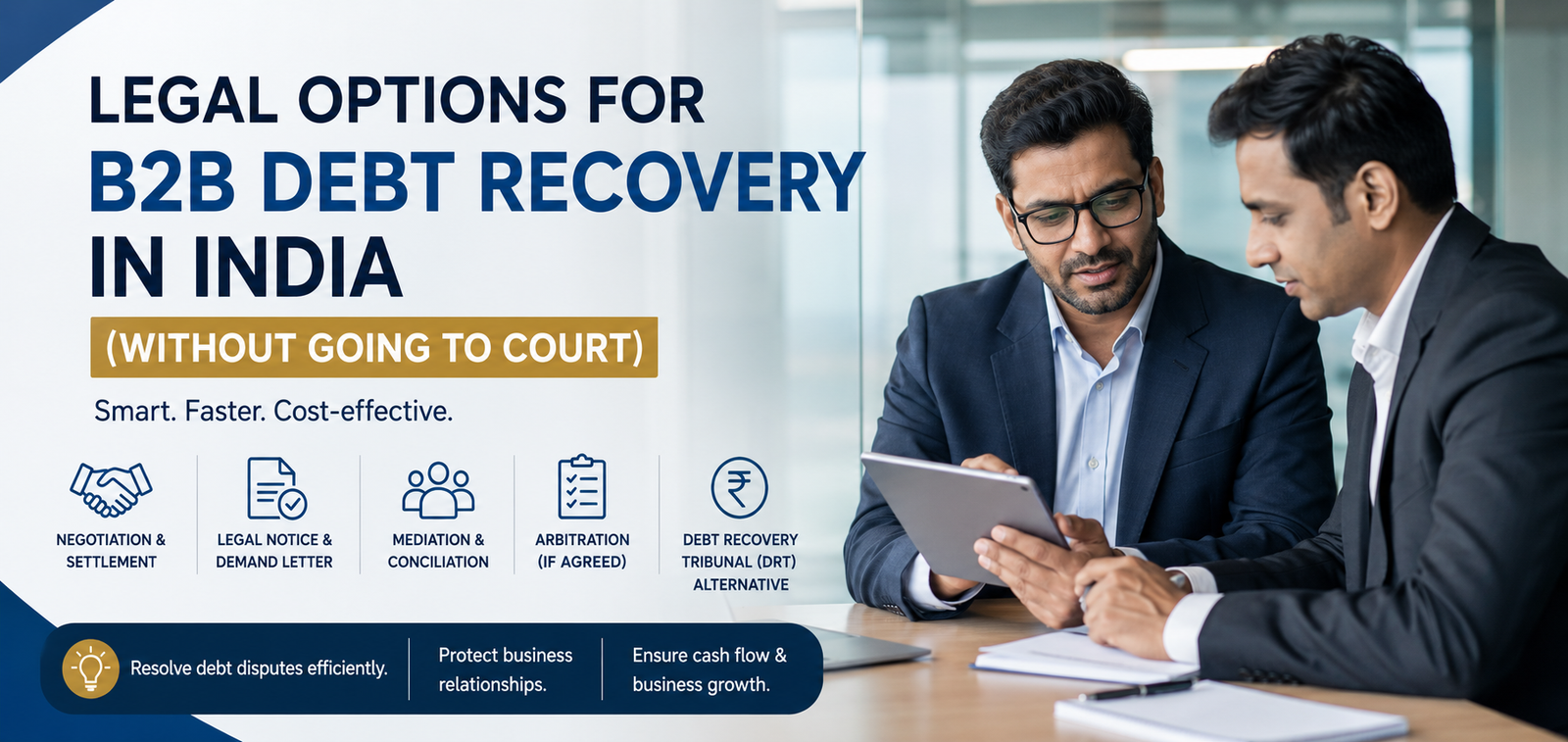
Court isn't always the right first move when a client owes you money. Civil litigation in India can take years, costs add up fast, and a lawsuit often permanently ends a business relationship you might otherwise have repaired. The good news: Indian law and commercial practice offer several legitimate, enforceable ways to recover B2B dues without ever stepping into a courtroom.
Here's a practical rundown of your options, roughly in the order most recovery professionals try them.
1. Direct Negotiation with a Structured Payment Plan
The fastest and cheapest recovery method is almost always a direct conversation. Many B2B clients aren't refusing to pay out of bad faith — they're managing their own cash flow crunch. Before escalating, propose a written, time-bound payment plan (e.g., 30% now, balance in two installments over 60 days) and get it signed or confirmed over email.
This isn't just diplomacy — a signed acknowledgment of debt also resets the limitation period and strengthens your position if you do need to escalate later.
2. A Formal Legal Notice
A legal notice — sent by a lawyer or a recovery agency on your letterhead — sits just below litigation but well above an informal reminder. It states the amount owed, the deadline to pay, and what happens if the deadline passes.
This step alone resolves a large share of disputes, because it signals you're prepared to escalate and gives the debtor a face-saving final window to settle without public legal proceedings.
3. MSME Samadhaan (If You're Udyam-Registered)
If your business holds Udyam (MSME) registration, the MSME Samadhaan portal lets you file a payment delay complaint directly with the Micro and Small Enterprises Facilitation Council (MSEFC) — a government body, not a civil court.
How it works:
- The buyer is required to pay within 45 days of accepting goods/services
- If they don't, the Council first attempts conciliation between both parties — a structured, faster negotiation process
- If conciliation fails, the matter goes to arbitration under the council itself (still not a civil court), and the buyer becomes liable for compound interest at 3 times the RBI bank rate
This is one of the strongest non-court tools available to small businesses, precisely because the interest penalty gives debtors a real incentive to settle during conciliation rather than let it drag on.
4. Arbitration
If your contract or purchase order includes an arbitration clause, you can invoke it directly — no need to file a civil suit. Arbitration is a private, binding dispute resolution process under the Arbitration and Conciliation Act, 1996, where a neutral arbitrator (or panel) hears both sides and issues an award.
Why businesses prefer it:
- Faster than court (often resolved in months, not years)
- Confidential — useful if you don't want a dispute with a client becoming public record
- The resulting award is enforceable exactly like a court decree, so it's not a "weaker" outcome — just a faster, more private path to one
5. Mediation
Mediation involves a neutral third party helping both sides reach a voluntary settlement — there's no binding decision imposed, but agreements reached are typically converted into an enforceable settlement contract. For commercial disputes, India's Commercial Courts Act actually mandates a pre-litigation mediation attempt (via the Mediation and Conciliation Rules) before certain categories of suits can even be filed — meaning many businesses end up trying this step whether they plan to or not.
It's worth attempting proactively rather than waiting to be required to: a mediated settlement preserves the business relationship far better than any adversarial process.
6. Lok Adalat
For smaller-value or straightforward disputes, Lok Adalats (people's courts, organized under the Legal Services Authorities Act) offer free, fast, informal settlement hearings. They're typically used for simpler, less contested claims, and any settlement reached has the same legal force as a civil court decree — but without the procedural delay of regular litigation.
7. Engage a Professional B2B Debt Recovery Service
For businesses without the time or legal bandwidth to manage notices, MSME filings, and negotiation cycles themselves, a dedicated recovery agency can run the entire non-court process — drafting and sending notices, filing MSME Samadhaan applications, negotiating settlements, and applying structured pressure — usually on a success-based fee, so there's no upfront cost if the case doesn't recover.
8. Compliance and Reputational Leverage
A few additional pressure points that don't involve any tribunal or court at all:
- GST input credit pressure: An unpaid invoice can affect the debtor's ability to claim input tax credit, which is sometimes a useful point of leverage in settlement conversations.
- Credit bureau reporting: For larger or repeat-default debtors, reporting the default (where applicable mechanisms exist) can motivate faster settlement.
- Vendor/banking reputation risk: Many B2B debtors settle simply to avoid a recovery dispute becoming visible to their other suppliers, partners, or lenders.
Comparison at a Glance
| Method | Cost | Typical Speed | Binding? | Best For |
|---|---|---|---|---|
| Direct negotiation | Free | Days–weeks | If signed, yes | Genuine cash flow delays |
| Legal notice | Low | 1–4 weeks | No (pressure tool) | Almost every case, as a first formal step |
| MSME Samadhaan | Low–moderate | Weeks–months | Yes (post-arbitration) | Udyam-registered sellers |
| Arbitration | Moderate | Months | Yes | Contracts with an arbitration clause |
| Mediation | Low | Weeks–months | Yes (if settled) | Preserving the relationship |
| Lok Adalat | Free/minimal | Days–weeks | Yes | Smaller, less contested claims |
| Recovery agency | Success-based | Varies | Depends on method used | Businesses without bandwidth to self-manage |
When You Might Still Need Court
Out-of-court options work best when there's no serious dispute over the debt itself — just delay or reluctance to pay. If the client disputes the quality of goods/services, denies the contract terms entirely, or the amount is large and contested, civil litigation (or, for large undisputed corporate debts, insolvency proceedings under the IBC) may become unavoidable. Even then, most of these non-court steps — especially the legal notice and a documented settlement attempt — strengthen your position if the matter does eventually go to court.
Final Thoughts
Litigation should usually be the last resort, not the first move. Between direct negotiation, MSME Samadhaan, arbitration, mediation, and Lok Adalats, Indian businesses have more non-court recovery tools available today than most people realize — and using them in the right order often recovers dues faster, cheaper, and with the business relationship still intact.