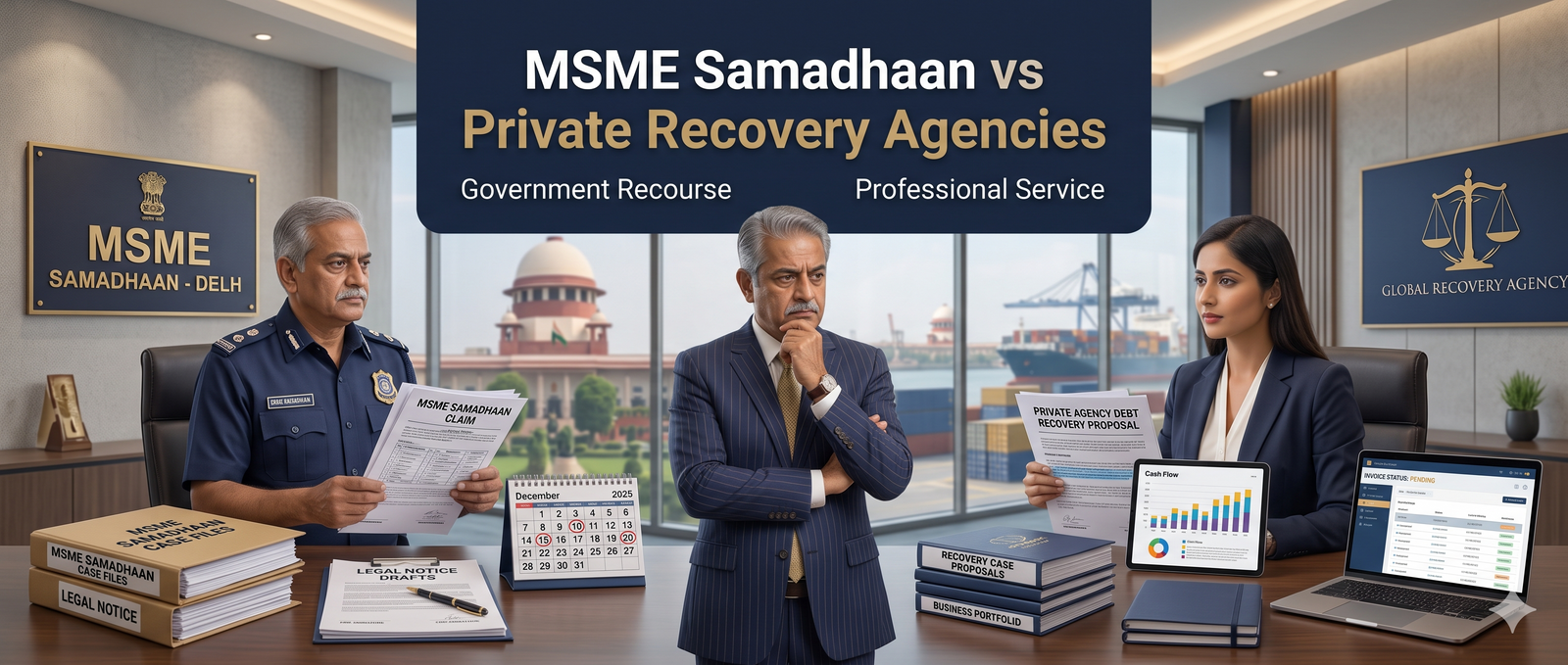
If you're owed money by a B2B client, you generally have two very different paths to pursue recovery without going straight to court: the government's MSME Samadhaan portal, or a private debt recovery agency. They're not mutually exclusive — but understanding what each one actually does (and doesn't) helps you choose the right starting point.
What Is MSME Samadhaan?
MSME Samadhaan is a government portal that lets Udyam (MSME)-registered sellers file payment delay complaints against buyers who haven't paid within 45 days of accepting goods or services. The complaint goes to the Micro and Small Enterprises Facilitation Council (MSEFC), which first attempts conciliation, then moves to arbitration if needed. Buyers who delay become liable for compound interest at three times the RBI bank rate.
What Does a Private Recovery Agency Do?
A private recovery agency manages the end-to-end recovery process on your behalf — sending demand letters and legal notices, negotiating directly with the debtor, filing MSME Samadhaan applications where applicable, pursuing civil or criminal remedies, and applying structured pressure (often including legal counsel) until the matter resolves. Most operate on a success-based fee, meaning you only pay a percentage if they actually recover the money.
Key Differences
| Factor | MSME Samadhaan | Private Recovery Agency |
|---|---|---|
| Eligibility | Only Udyam-registered MSME sellers | Any business, MSME or not |
| Cost | Free / government fee | Success-based fee (typically a % of recovery) |
| Effort required from you | You file and follow up yourself | Agency manages the entire process |
| Speed | Weeks to a few months (conciliation), longer if it reaches arbitration | Varies — agencies often run multiple pressure points in parallel |
| Scope | Statutory remedy under one specific Act | Can combine multiple legal and negotiation tools |
| Interest penalty | Built-in (3x RBI bank rate) | Not automatic — depends on what's pursued |
| Best for | Straightforward MSME payment delays | Complex cases, non-MSME claims, or when you lack time/expertise |
When MSME Samadhaan Makes Sense
If you're Udyam-registered and the buyer has genuinely accepted your goods or services without dispute, Samadhaan is often the most cost-effective first move — it's free, has a real financial penalty built in, and doesn't require hiring anyone. It works best for straightforward delays where there's no serious dispute over the underlying transaction.
When a Private Agency Makes More Sense
A recovery agency becomes more valuable when:
- You're not MSME-registered, so Samadhaan isn't available to you
- The debtor is disputing the claim, stalling deliberately, or unresponsive to a government filing
- You don't have the bandwidth to manage notices, follow-ups, and filings yourself
- You want multiple recovery levers — legal notice, negotiation, compliance pressure, and potential litigation — coordinated together rather than run one at a time
- The amount involved justifies a success fee in exchange for faster, hands-off recovery
Can You Use Both?
Yes — and many recovery professionals do exactly this. A private agency can file and manage your MSME Samadhaan application on your behalf, while simultaneously running a legal notice and negotiation track. This combines the statutory leverage of Samadhaan (the interest penalty, the government forum) with the speed and coordination of a dedicated recovery process — often producing faster results than either approach alone.
Final Thoughts
MSME Samadhaan is a powerful, no-cost tool — but only if you're registered and the case is relatively straightforward. For everything else (or for MSME cases where you simply don't have time to manage the filing yourself), a professional recovery service fills the gap, managing the process end-to-end and aligning its fee with actually getting you paid.