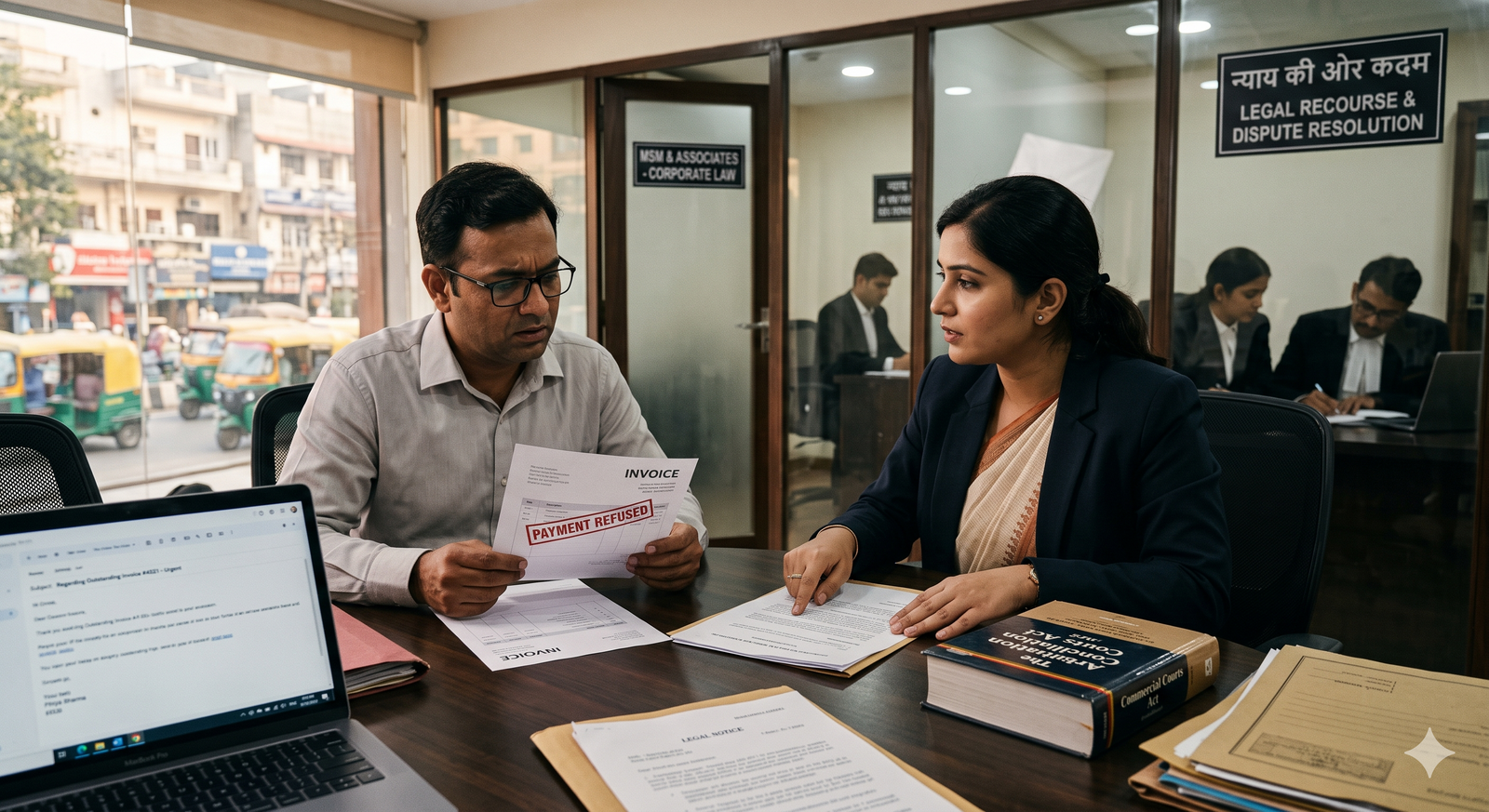
Unpaid invoices are one of the most common — and most stressful — problems for businesses in India. Whether you run a manufacturing unit, a service agency, or a trading firm, a client who delays or refuses payment doesn't just hurt your cash flow; it puts your own ability to pay suppliers, salaries, and taxes at risk.
The good news: Indian law gives businesses several structured ways to recover dues, ranging from a simple reminder to formal legal action. This guide walks through what to do, in the right order, so you protect your cash flow without burning the business relationship unnecessarily.
Step 1: Don't Skip the Basics — Document Everything First
Before you escalate, make sure your paperwork is in order. Recovery becomes far easier (and faster) when you can show:
- A signed purchase order, work order, or service agreement
- The invoice itself, with clear payment terms and due date
- Proof of delivery or completion (e-way bills, delivery receipts, signed acceptance, email confirmations)
- Any WhatsApp, email, or written communication acknowledging the dues
Courts, MSME facilitation councils, and arbitrators all rely heavily on documentary evidence. A well-documented file often resolves a dispute before it even needs to go anywhere formal — debtors are far more likely to pay once they see you have a clean paper trail.
Step 2: Start with a Firm but Professional Follow-Up
Many "refusals" to pay are actually delays caused by cash flow issues, internal approval bottlenecks, or genuine disputes over delivery/quality. A short call or email asking for a clear payment date — in writing — is always the first move. Keep records of this communication; it becomes useful later if the matter escalates.
If the client is non-responsive or keeps deferring without a real commitment, move to the next step.
Step 3: Send a Formal Legal Notice
A legal notice, sent through a lawyer or a registered recovery service, is often the turning point. It signals that you're serious and gives the client a final opportunity to pay before legal proceedings begin.
A good legal notice typically includes:
- A clear statement of the outstanding amount and the invoices it relates to
- The due date and the number of days of delay
- A specific deadline to pay (commonly 15 days)
- A warning of the legal steps that will follow if payment isn't made
In practice, a significant share of disputes settle at this stage simply because the client realizes you're prepared to escalate.
Step 4: Know Your Legal Options Under Indian Law
If the legal notice doesn't work, you have several routes depending on your business type, the amount involved, and how the client defaulted.
A. MSME Samadhaan (If You're a Registered MSME)
If your business is registered under the MSME Development Act, 2006 (Udyam Registration), you have a powerful advantage: buyers are legally required to pay MSME suppliers within 45 days of acceptance of goods/services. If they don't, you can file a case with the MSME Samadhaan portal (a government platform specifically for MSME payment delays).
Key benefits of this route:
- It's a relatively low-cost, semi-judicial process via the Micro and Small Enterprises Facilitation Council (MSEFC)
- The buyer is liable to pay compound interest at 3x the RBI bank rate on the delayed amount — a strong incentive for them to settle quickly
- The Council can refer the case to conciliation or arbitration, often resolving disputes faster than civil court
This is usually the fastest and most cost-effective option if you qualify.
B. Section 138, Negotiable Instruments Act (If a Cheque Bounced)
If the client issued a cheque that was dishonoured (insufficient funds, signature mismatch, account closed, etc.), this is a criminal offence under Section 138 of the NI Act. You must:
- Send a notice within 30 days of receiving the bank's dishonour memo
- Wait 15 days for payment
- If unpaid, file a criminal complaint within 30 days of the notice period lapsing
This route carries real weight because non-payment can lead to imprisonment and fines, making it a strong pressure point — but it only applies where a cheque was actually issued and bounced.
C. Civil Suit for Recovery of Money
For straightforward non-payment without a cheque or MSME registration, you can file a civil recovery suit under the Code of Civil Procedure. For commercial disputes above ₹3 lakh, this typically goes through the Commercial Courts, which are designed to move faster than regular civil courts and include mandatory pre-institution mediation in many cases.
This route takes longer than MSME Samadhaan but is appropriate for larger or more contested claims, and results in an enforceable court decree.
D. Arbitration (If Your Contract Has an Arbitration Clause)
If your agreement includes an arbitration clause, you're generally required to resolve the dispute through arbitration rather than court. This is often faster and more private than litigation, and the resulting award is enforceable like a court decree under the Arbitration and Conciliation Act, 1996.
E. Insolvency and Bankruptcy Code (IBC) — For Larger Claims
If the outstanding amount is ₹1 crore or more and undisputed, you (as an "operational creditor") can file an application under Section 9 of the IBC before the National Company Law Tribunal (NCLT) to initiate insolvency proceedings against the defaulting company. This is a serious step — the mere filing often pushes companies to settle quickly to avoid reputational and operational fallout — but it's reserved for genuinely large, clear-cut dues.
Step 5: Use Compliance Leverage Where Available
A few practical pressure points worth knowing:
- GST mismatch pressure: If you've issued a GST invoice and the client hasn't paid, it can affect their input tax credit claims, which is sometimes a useful point of leverage in negotiations.
- Credit reporting: For larger, repeat-offender debtors, flagging the default to credit information companies (where applicable) can motivate settlement.
- Reputational pressure: For B2B clients especially, the threat of formal recovery action becoming visible to their other vendors, banks, or partners is often enough to prompt payment.
Step 6: When to Bring in Professional Help
Many businesses delay action because they don't have the bandwidth to chase legal notices, MSME filings, or court procedures while running daily operations. This is where a dedicated B2B debt recovery service becomes useful — handling notices, MSME Samadhaan filings, and escalation strategy on a success-based fee, so you only pay when you recover.